


.png)


TLDR; AI is no longer a future concept, it’s becoming embedded in every part of how we live, work, and interact. In this whitepaper, we explore how businesses can stay ahead in an age of rapid technological change, and what it takes to lead responsibly as AI becomes more pervasive.
From evolving customer expectations to new regulatory frameworks and the rise of large language models, we unpack the key shifts that will define the next decade and what leaders must do to prepare.
Moving beyond experiementation
Radical innovation driven by advanced Artificial Intelligence is here. Over the last two years, especially since the debut of Open AI's ChatGPT, we've seen major deployments of Generative AI across a range of industries.
Up until now, many of these Gen AI applications have been in a 'proof of concept' phase, with organisations needing to prove their impact on efficiency, logistics and bottom-line ROI.
Heading into 2025, companies are moving past this experimentation phase, looking to scale up Gen AI across customer service, engineering, R&D, operations, business development and content creation, to name a few.
With these rollouts, whole sectors of the business services and consumer application landscapes are set to be redefined, with three areas of innovation, in our opinion, emerging as the driving force behind this new frontier:
- A mass scale-up of generative AI across all organisational touch-points, estimated to boost workforce efficiency by up to 30%.
- The emergence of Agentic AI - almost completely autonomous AI agents that can augment human capabilities.
- New forms of co-piloted intelligence and mass roll out into smartphones, laptops and GPUs.
Unsurprisingly tech giants and venture capital are at the helm, with an unprecedented uplift in capital expenditure being spent in AI technologies, in addition to a doubling down on investment into AI startups, Agentic AI start-ups in particular, which has reached over $2 billion over the last two years.
Gen AI, Agentic AI and daily interactions with copiloted intelligence won't simply affect organisational operations and business structures—they will fundamentally redefine the entire landscape of work and our relationship to labour.
Bain's 2024 Technology Report has warned companies will be unable to scale their AI solutions without completely reshaping their architecture and ways of working.
One question is becoming increasingly pertinent for every organisation; how do we adapt?
Key AI market trends for 2025
- CapEx in AI development is set to hit $200 bn globally by 2025, driven by tech giants Alphabet, Microsoft, Meta and Amazon.
- Leaders in automation are set to allocate up to 75% of IT budgets to GenAI in 2025, greatly outpacing other organisations.
- The Total Addressable Market (TAM) for AI is predicted to grow up to 55% in 2025, potentially reaching up to $990 bn by 2027.
- 25% of enterprises using GenAI are forecast to deploy AI agents in 2025, potentially growing to 50% by 2027.
- AI workloads are predicted to grow up to 35% in 2025, focused on model training and fine-tuning Large Language Models (LLMs).
The drive for exceptional customer experience
Sitting parallel to the boom in AI investment is a growing demand for exceptional customer experiences. With the rise of Gen-Z consumers, positive customer care interactions are becoming increasingly integral to how businesses are perceived by the market.
Forbes recently reported that bad customer service experience could be costing the global economy as much as $3.7 trillion a year.
Gen AI, and the new advancements in Agentic AI, are increasingly providing pivotal solutions to this market demand — transforming how high-growth organisations are approaching their customer service, both from the perspective of their bottom line and the overall experience they're providing their valued customer base.
For example, Klarna, the AI-powered global payments network, stated earlier this year that up to 66% of its customer service chats are now handled by an AI assistant.
AI offers a strategic way to simultaneously scale and optimise customer service operations, improving the three key components of exceptional customer support.
Knowledge
Trained on huge amounts of data, AI assistants can give customers almost instant access to any information or assistance they need.
Speed
Carrying out previously labour-intensive tasks in a fraction of the time, AI assistants can be available 24/7, with no limit to the number of customers serviced.
Personalisation
With the ability to sift through entire interaction histories and customer profiles in seconds, AI assistants can support customers with entirely personalised journeys and interactions.
Reshaping the tech stack
Fundamentally, companies will be unable to adapt or scale up their AI solutions without reshaping their tech stack. Bain & Co has coined this as taking an "AI everywhere" approach.
This involves upgrading ways of working to incorporate AI but also to begin integrating ML and Gen AI into enterprise software and operational systems.
CIOs and CPOs will need to decide between building or buying, in addition to being increasingly prudent about working with partners who also have the capabilities to adapt their own technologies and products to incorporate AI.
How is this set to impact your collections partners?
The debt resolution industry has been slow to adopt AI, but it's no different to any other technology sector or service provider.
DCAs and collections platforms that haven't taken an AI-first approach to development will struggle to keep up with the advancements in AI and the need to be ever-more agile. This will largely be due to the already apparent disparity between the negative cost and customer experience implications of traditional or solely human agent-driven approaches.
Collections platforms and tech stacks need to rapidly pivot to fully AI-native, or 'AI everywhere' solutions if they want to stay competitive.
Choosing an AI-native partner is important for future-proofing your collections and ensuring scalability, water-tight compliance and, crucially, enhanced customer experience.
What does AI-native mean?
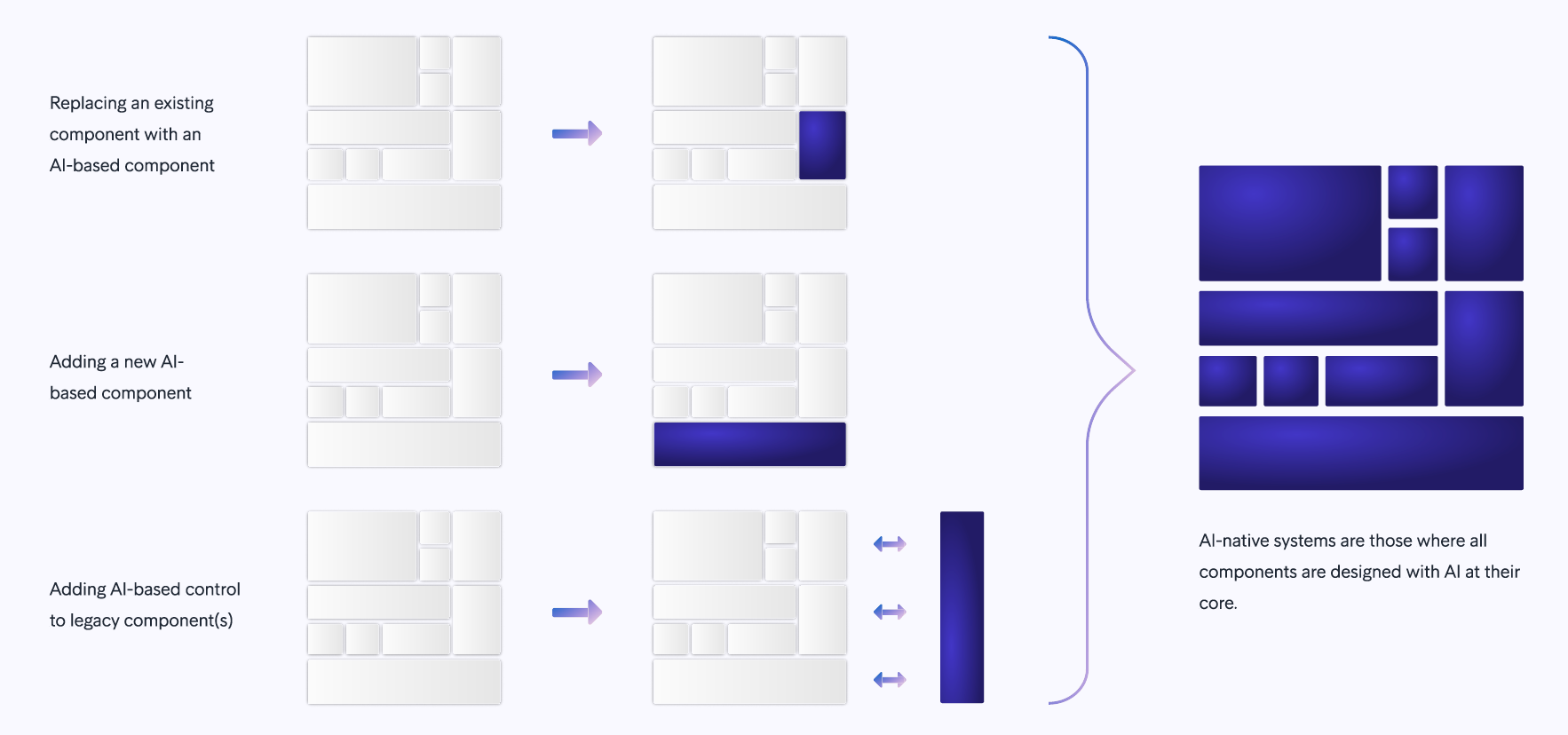
Unlike legacy AI or embedded AI technologies that integrate AI as retrofitted components, often into existing systems, AI-native stacks are built with AI not just as a feature, but as the foundation for the entire system. AI-native platforms are designed to handle complex, end-to-end data-driven decision-making that utilises AI across all system functions.
These stacks sit at the frontier of AI's capabilities, owing to the fact that they can continuously employ machine learning (ML) and reasoning to optimise and improve processes. Essentially, this means the system can learn and adapt autonomously, rather than relying on set prompts or logic trees.
Whilst embedded AI has enabled the debt industry and many other financial services to enhance performance via automation and improved efficiency, the future truly lies with dynamic, end-to-end native systems.
Ways of adding AI to a system
Future-proofing your collections process
2025 is set to be the most revolutionary year yet for AI deployments. Mass scale-up of Gen AI, the emergence of Agentic AI and further global rollout of co-pilot intelligence are set to drive radical shifts in how organisations are adopting AI technologies.
The time to innovate is now. To be ahead of the curve, businesses need to adopt fresh-thinking and radical new approaches to their tech stacks and operations—with AI everywhere being key.
Collections partners are no different, with companies needing to look for DCAs that can adapt and deliver exceptional customer service with AI solutions.
With the power to deliver granular personalisation at scale and continuously optimise with little need for human intervention, AI-native platforms are forging a new frontier for debt resolution.
If you'd like to find out more about how AI-native technology could enhance your customer engagement, book a demo with our team.
Download the whitepaper in full:


